June 5, 2026
Mobile App Penetration Testing: Methodology, Tools & Checklist
Mobile App Penetration Testing: Methodology, Tools & Checklist

Fiza Nadeem


Fiza Nadeem is an SEO content writer at ioSENTRIX with 2.5+ years of experience in content writing, copywriting, and SEO.
Compliance must evolve beyond static checklists because modern risk environments change faster than periodic audits can detect.
Regulators increasingly expect continuous risk management rather than point-in-time evidence of control presence.
Gartner estimates that 99% of cloud security failures are caused by customer misconfiguration, highlighting persistent operational gaps that audits alone do not address.
Traditional compliance validates documentation. Modern compliance validates control effectiveness, operational outcomes, and resilience under real-world threat conditions.
Checklist-driven compliance creates blind spots that increase breach, regulatory, and reputational risks. Organizations often pass audits while remaining vulnerable to cloud misconfigurations, API abuse, and AI model risks.
Key risks include:
Strategic compliance aligns security controls with business objectives, enabling faster sales cycles and higher trust.
Research shows that automation of compliance processes and integrated compliance systems can reduce onboarding or manual compliance processing time by up to 25%, improving operational efficiency and customer experience.
Compliance maturity signals operational discipline to customers, regulators, and investors. Benefits include:
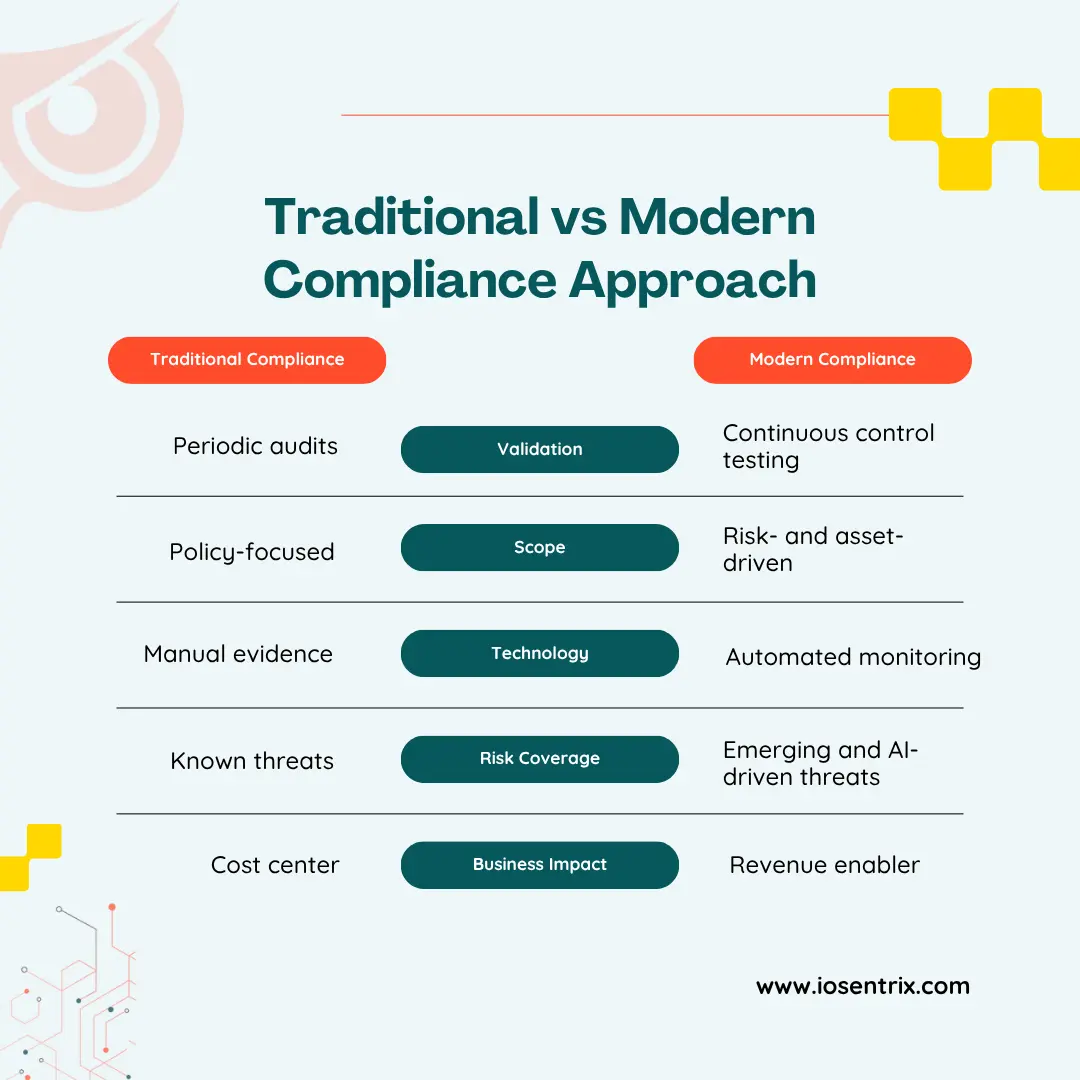
Modern compliance programs prioritize continuous validation, risk context, and control performance. They integrate security operations, governance, and automation instead of operating in silos.
Traditional vs Modern Compliance Approach
Continuous risk assessment ensures controls remain effective as infrastructure, threats, and regulations evolve.
NIST emphasizes that static risk assessments fail to address cloud elasticity and AI system behavior. Organizations managing AI, APIs, and decentralized infrastructure face dynamic exposure.
ioSENTRIX supports continuous assessment across:
Well-implemented frameworks demonstrate governance maturity and operational resilience. Framework alignment reduces friction during customer audits and regulatory reviews.
Key frameworks organizations must operationalize
AI introduces non-deterministic behavior that traditional controls were not designed to manage. According to MIT research, AI systems can bypass rule-based security controls through emergent behavior.
Organizations must address risks across data, models, and deployment pipelines. Critical AI-related compliance risks include:
Regulators increasingly require proof that controls work under realistic threat scenarios. The FFIEC highlights that documented policies alone do not demonstrate cyber resilience.
Evidence must show detection, response, and recovery capabilities. Key regulatory tools include:
Organizations must embed compliance into architecture, development, and operations. This approach reduces friction, cost, and audit fatigue.
Core operational steps include:
ioSENTRIX enables organizations to transform compliance into measurable security maturity. Its approach focuses on continuous validation, AI risk modeling, and regulatory alignment.
Organizations benefit from:
Ready to move beyond checklists and turn compliance into a strategic advantage? Contact ioSENTRIX to get started.
Compliance becomes a competitive advantage when it demonstrates real security maturity that accelerates trust, sales, and regulatory approval.
Checklists fail to validate whether controls remain effective against evolving threats and modern infrastructure risks.
AI introduces dynamic behavior, third-party dependencies, and data risks that traditional compliance controls cannot fully address.
SOC 2, PCI DSS, HIPAA, and FFIEC-aligned controls are critical depending on data sensitivity and market focus.
Risk assessments should be continuous, with formal reviews at least quarterly or after material system changes.